



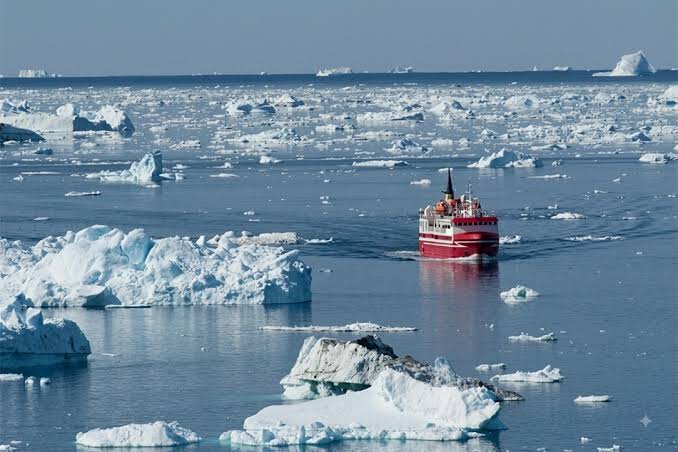
China prepares to ship through the ‘Ice Silk Road’, evading maritime chokepoints in gridlock
Sea Legend Shipping, a Chinese shipping start-up, will conduct the first regular container shipment service across the Arctic this week. The route bypasses traditional ocean freight routes – currently at a stalemate due to geopolitical tensions – and benefits from shorter shipping periods, further magnified by the melting of ice caps.
The company launched the China-Europe container service through the Northern Sea Route (deemed the ‘Ice Silk Road’) just over a year ago, aiming to cut typical shipping durations. A successful trial voyage took place last September: Istanbul Bridge, a vessel holding nearly 4,000 containers of electric vehicles (EVs), batteries, and solar panels, left Ningbo Zhousan and sailed to the UK’s Felixstowe in just 20 days.
This was roughly half the time it takes to transit via the conventional routes of the Suez Canal or the Cape of Good Hope. According to Li Xiaobin, the company’s Chief Operating Officer, the shorter route also reduced required business inventory by around 40%, cutting not only time but also costs.
A service called the China-Europe Arctic Express (CAX) is scaling the initiative now. Cargo collections are set to begin at Ningbo Zhousan on 12 August, kickstarting eight weekly departures planned from 15 August through 3 October. The primary destinations will be Felixstowe, Rotterdam, Germany’s Wilhelmshaven, and the Port of Gdynia in Poland.
The service will involve vessels carrying standard and refrigerated containers, sailing off the northern coast of Russia – a journey previously ventured by Maersk in 2018, and by smaller Chinese and Russian operators since 2022 (but for smaller cargo and bound mainly for Russia).
Maersk’s expedition in 2018 was merely a trial run, designed primarily to gain operational experience in a new zone while testing vessel systems and shore-based support setups. Despite the trial’s apparent success, the passage was deemed non-worthwhile – a viable route only three months a year (subject to change with shifting climate patterns), mandating additional investment into ice-classed vessels and risking damage to the Arctic’s ecosystem.
However, unlike Maersk’s venture, Sea Legend’s Istanbul Bridge completed the journey without icebreaker assistance, relying instead on the seasonal low ice window.
The North Sea Route, which runs 5,500 kilometers along the Russian coast, is covered by solid pack ice in winter, but large stretches of ice-free zones tend to open up around September.
This is growing increasingly common, as ice in the Arctic sea during peak winter dropped 5.8% between 2024 and 2025, marking the biggest plunge recorded in modern history.
Carbon emitted by maritime shipments are among the biggest environmental issues affecting the Arctic. Black carbon – matter oozing from ships burning heavy fuel oil and marine diesel – settles on ice and darkens its surface; dark surfaces absorb more sunlight, which in turn accelerates the melting of ice.
But Arctic and non-Arctic states have diverging stakes in how strictly black carbon is regulated. For instance, Russia, who administers the North Sea Route, collects transit fees and promotes the route as a strategic commercial corridor. It’s investing roughly $24 billion into the route’s development by 2035, and in 2024, while the International Maritime Organization (IMO) banned the use of heavy fuel oil in Arctic waters – a marine protected area – Russia used the IMO’s built-in legal exemptions and waived the ban until 2029.
Non-Arctic states, particularly those of the European Union (EU), often push for stricter environmental standards.
However, amidst ongoing disruption in key waterways – such as the effective closure of the Strait of Hormuz and the current impasse in the Red Sea affecting the Bab-el-Mandeb and Suez Canal chokepoints – alternative trade routes are gaining importance.
Sea Legend Shipping has a history of benefitting from geopolitical disruption: in 2023, the company leveraged its Chinese ownership to secure safe passage through the Red Sea, while Houthi attacks halted shipments for many western carriers.
Since the recent resurgence of conflict in the Red Sea, China has held talks with the Houthis to obtain safe crossing.
