



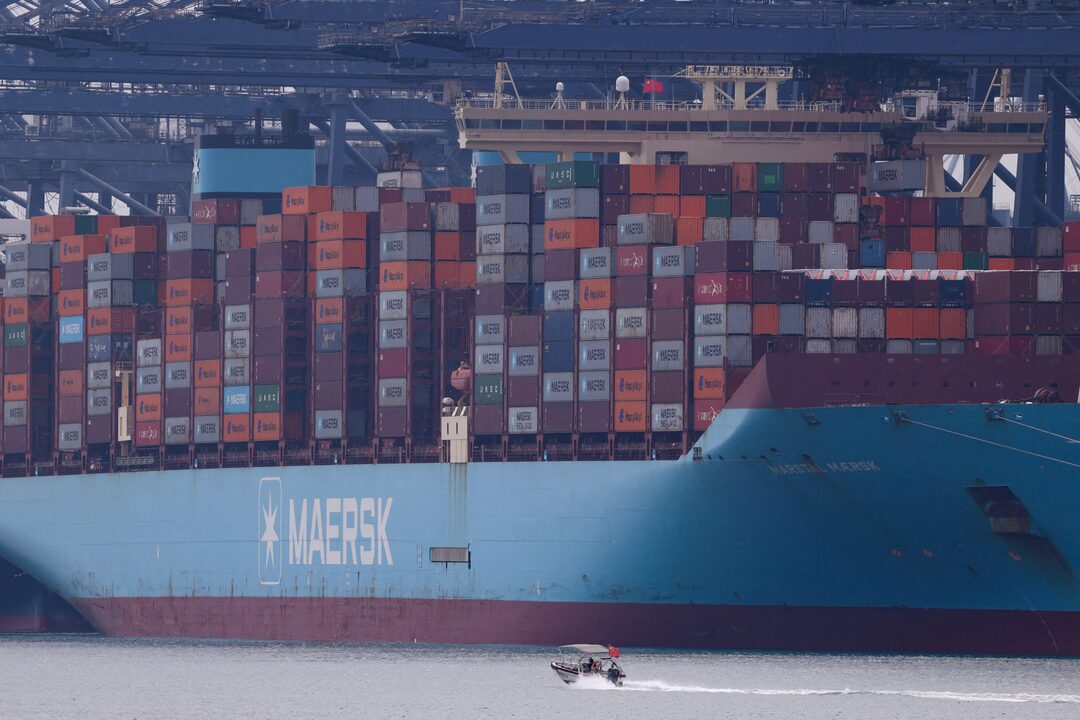
Maersk increases quarterly revenue by 27% and raises its 2026 financial guidance
Danish shipping and logistics group Maersk reported revenue of $18.1 billion in the third quarter of 2026, representing a 27% increase year-on-year. Group EBITDA rose from $2.7 billion to $4.7 billion, while operating profit (EBIT) increased from $1.3 billion to $3.3 billion, with an EBIT margin of 18.1%. The results were supported by 2–4% growth in global container demand and a 46% quarter-on-quarter increase in average spot freight rates. Meanwhile, severe typhoons in Asia caused widespread port congestion, pushing global average vessel waiting times to a peak of 16.6 hours, the highest level since January 2023. In the Ocean segment, EBIT reached $2.6 billion compared with $567 million a year earlier, while vessel utilisation remained at 96% despite weather-related disruptions, the continued closure of the Strait of Hormuz and rising bunker fuel and container handling costs.
Revenue in Maersk’s Logistics & Services division increased by 13%, driven by higher landside transport volumes, alternative landbridge solutions across the Gulf region and strong demand for air freight and project logistics. The segment’s EBIT margin improved from 5.5% to 5.8%. The Terminals business also achieved record revenue, with handling volumes rising by 2.6%, including growth of 14% in Africa and 6.7% in Europe. Terminal utilisation stood at 85%, while the adjusted EBIT margin reached 32.5%. At the same time, the group continued expanding its infrastructure. APM Terminals began construction of the Laldia terminal in Chattogram, Bangladesh, which will add 900,000 TEU of annual capacity, and launched operations at the new Suape terminal in Brazil, initially providing up to 400,000 TEU of annual handling capacity and increasing the port complex’s capacity by 55%. Maersk also ordered 26 dual-fuel container vessels, each with a capacity of 18,600 TEU, scheduled for delivery in 2029–2030.
Following its stronger financial performance, Maersk raised its full-year 2026 guidance, assuming global container market growth of approximately 4%. The company now expects underlying EBITDA of $14–14.5 billion and underlying EBIT of $8–8.5 billion, compared with previous forecasts of $10.5–12.5 billion and $4.5–6.5 billion, respectively. Free cash flow is projected to exceed $3 billion, while capital expenditure guidance remains unchanged at $10–11 billion for both the 2025–2026 and 2026–2027 periods. However, Maersk cautioned that its financial performance remains sensitive to freight rates, bunker fuel prices and macroeconomic uncertainty. A change of $100 per forty-foot equivalent unit (FFE) in container freight rates could affect annual operating profit by approximately $300 million.
